
Samuel Palmer and the Bright Cloud motif – an Aid to Devotion?
Last fortnight I analysed a work by the artist Ferdinand Oliver – this week I follow this with a return to one of my favourite artists Samuel Palmer one of the greatest English artists who expressed the transcendent through the use of Landscape Paintings.
As Oliver spent most of his time in Germany, he would have been aware of the principles being espoused by Schelling in his Philosophy of Art and the way in which the latter was promoting the use of landscape as a means of signifying the relationship between mankind and his or her Creator. While Palmer did not spend any great length of time in Germany, he was at times in close contact with Coleridge and with H.C. Robinson both of whom spent time in Germany studying philosophy and aesthetics and he would have been imbued with the notions of that time.
Samuel Palmer would have been close in theological outlook to Ferdinand Oliver and both expressed their relationship to the creator through the depiction of idyllic landscapes. Both chose to ignore either through ignorance or deliberate intention the hardship and drudgery of farm work in the nineteenth century and expressed a benign outlook that would invoke in the viewer the encouragement to praise God and give thanks for such a wonderful creation. Oliver’s and Palmer’s works are too small to be used as altarpieces in a church or cathedral but both would be appropriate in a small side chapel or monk’s cell and most certainly could be used for devotional purposes when the viewer would contemplate the Creation.
The cloud motif was an important one for Palmer, emphasised in this extract from a letter to his friend John Linnell: ‘Nor must be forgotten the motley clouding, the fine meshes, the aerial tissues that dapple the skies of spring; nor the rolling volumes and piled mountains of light.’ He saw in the treatment of clouds in Linnell’s own paintings ‘how the elements of nature may be transmitted into the pure Gold of Art.’[i]
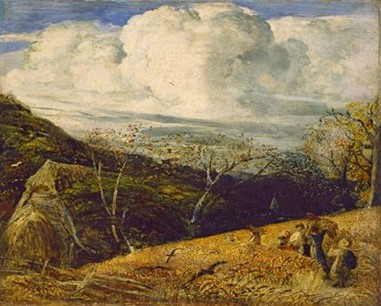
Palmer The Bright Cloud (1833-4) 233 x 320 mm Oil and tempera on mahogany board
This motif is included in two paintings by Palmer produced towards the end of his time in Shoreham – The White Cloud (1833-4) and The Bright Cloud (1833-4) – as well as the earlier sepia Valley with a bright Cloud (1825) – all of which have those characteristics which point towards the Transcendent. They are small paintings but certainly could be used in a side chapel or small chamber as an aid to contemplation of the numinous.
While the two ‘cloud’ paintings are almost mirror images of each other, The Bright Cloud has some similarity with the Rest on the Flight into Egypt (which was analysed in an earlier reflection) inasmuch as it shows what could be a biblical scene set in the countryside of Kent.
But both paintings show this tremendous building of cumulus cloud located such that it could almost be a representation of the Shekinah. One is reminded of the transfiguration passage in the Gospel of Matthew Chapter 17, verse 5 ‘when lo, a bright cloud overshadowed them, and a voice from the cloud said, “This is my beloved Son with whom I am well pleased”’, as well as the popular Advent hymn by Charles Wesley which Palmer would probably have known: ‘Lo! He comes with clouds descending …’[ii]
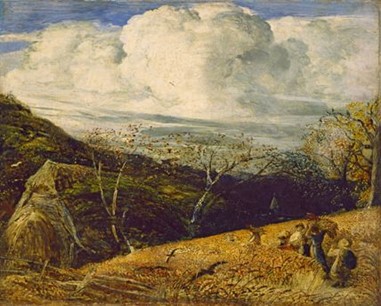
Palmer The White Cloud (1833-4) 222 x 267 mm Oil and tempera
Unlike Constable, Palmer did not set out to produce meteorologically accurate cloudscapes The White Cloud is a good representation of a cumulus cloud building eventually to become a towering cumulo-nimbus – the thunder cloud.
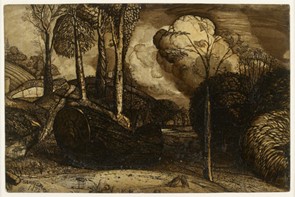 Palmer The Valley with a Bright Cloud (1825) 184 x 278 mm pen and brush in dark brown ink mixed with gum
It is surely not taking interpretation to an unreasonable length to suggest that the white cloud is representing a theophany – the Shekinah. Writing about the earlier sepia – The Valley with a Bright Cloud (1825), Vaughan suggests: ‘The ‘Bright Cloud’ was to become a favourite theme of Palmer’s during his later years at Shoreham and seems to suggest – as poetry referring to it then indicates – the image of a higher reality beyond the vale of comfortable rural peace’.[iii]
This particular painting was unusual for Palmer in not including any people, but he may have intended the picture to show paradise with God being represented by the church for he has written:
Landscape is of little value, but as it hints or expresses the haunts or doings of man. However gorgeous, it can be but Paradise without an Adam. Take away its churches, where for centuries the pure word of God has been read to the poor … and you have a frightful kind of Paradise left – a Paradise without a God.[iv]
Although no people, he has shown a church in the background and has annotated the picture with the comment ‘This is our life, exempt from public haunt, Finds tongues in trees, books in ye running brooks, Sermons in stones, and good in everything. As you like it.’[v] While the church symbolism is strong, once again it is the bright cloud which dominates the picture and is to me the representation of God – the Shekinah.
To summarise, these cloud works of Palmer are small but I would argue could be used in a similar manner to the icon of the Eastern Orthodox church and while not maybe venerated in the same way as the traditional icon, they could certainly be used as aids to devotion.
Dr David Greenwood. D.greenwood@uwtsd.ac.uk January 2022
[i] http://www.tate.org.uk/art/artworks/palmer-the-bright-cloud-n03312
[ii] Hymns Ancient and Modern Revised London William Clowes c1950 hymn 51, p. 56
[iii] Vaughan, W. Samuel Palmer – Vision and Landscape London British Museum Press 2006 p.89
[iv] Harrison, C. Samuel Palmer Oxford Ashmolean Museum 2010 p. 18.
[v] Ibid. p.18.
 Brislington Community News