
Last week I examined the word sacrament and looked at it in a very wide context and concluded that a work of art could act rather like a conduit permitting the viewer or communicant a sense of the spiritual realm that lies beyond the physical world This week I will extend that concept looking at the sacramental qualities of a work of art. But to begin I should just recapitulate on the meaning of the numinous.
To reiterate the meaning of numinous, as explained in an earlier reflection, this is a word introduced by Rudolf Otto in his book The Idea of the Holy and is intended to refer to the non-rational component in the concept of God. (The rational component derives from the fact that the concepts of God, for example creator, can be considered and defined in a way that is intellectually coherent.)
In refining the description of the non-rational when applied to the conception of God, Otto introduces three terms which taken together add up to that for which he has introduced the term numinous. The three terms are Tremendum which implies awfulness (that held in awe), majesty and energy; Mysterium – the mystery inherent in any concept of God, meaning blank wonder, stupor or astonishment; and Fascinans referring to the ‘bliss which embraces all those blessings that are indicated or suggested in a positive fashion by any “doctrine of salvation”… more than the intellect can conceive in them or affirm of them’.[i] So, the numinous is a term which refers to the bliss, the awfulness and the mystery involved in any appreciation of that Ultimate Reality the ‘Ground of All Being’ that is generally known by the name God.
As worship is the ‘response of the creature to the Eternal’, it follows that the experience of the sense of the numinous could be felt in an act of worship.[ii] As Otto writes, in devotional worship there is the ‘numinous silence of Sacrament’.[iii] For example in an act of worship practised by the Quakers, the first part of the service is concerned with ‘the instant when “God is in the midst”, experienced as “numen praesens”… ‘the experience of the transcendent in gracious intimate presence, “the Lord’s visitation of His people”’.[iv] This moment of transcendence or ‘numinous silence of sacrament’ can occur in many different types of service – a time of silence in morning prayer, when the minister invites the congregation to join a moment of silent contemplation, in the Eucharist at the time the celebration or in the Catholic Mass at the time of consecration..
If we accept Otto’s concept that there exists the numinous silence of sacrament, then if it can be shown that a work of art can help to focus the congregation by signifying the presence of God then it can be argued that such a work of art could, in itself, be regarded as a sacrament. The radical theologian Don Cupitt argues that the ‘major artists of Modernism and after – roughly, since the 1860s – can be viewed as prophets of a new religious order’ and that in the ‘Abstract Sacred we find an art which is both genuinely modern and genuinely religious.’[v]
Images have been used as an adjunct to worship since the time of pre-history – cave paintings have been found in France which are thought to be about 30,000 years old and were probably used as a basis for nature worship. However, if we concentrate on the Christian era, then from the earliest days of worship in church, painted images have played a part. Hans Belting, in his book Likeness and Presence, makes the distinction between narrative images and Holy Images, with only those images ‘that were lifted by an aura of the sacred out of the material world to which they otherwise belonged (taking) on real power’.[vi] Such images or icons – usually showing the face of Christ or a saint – became widely used in worship, particularly in the Eastern Orthodox Church.
Macquarrie draws a parallel between the Eastern Orthodox ‘appreciation of icons and the Western practice of praying in the presence of Christ in the reserved (sacrament or) eucharistic body. In both cases, a physical object, in the one an icon, in the other the consecrated bread, awaken(s) the spiritual susceptibilities of the worshipper.’[vii]
The question of from whence did the image, or, more pertinently the icon, gain its power remains open; Did iconicity gain its sacred power from the spiritual qualities inherent in the artist, or Did the image have to be consecrated by a priest from whom it would then gain its authority? It should, of course, be noted that nearly all works of art when installed in a church building are dedicated – by a theologian, sometimes a priest or with even higher authority, a bishop. However, the church authorities would have had to be satisfied that the work of art had those qualities that were appropriate for its use in the enhancement of worship. Therefore, that work of art would have had to have had the inherent sacredness prior to its dedication or consecration. By common consent, the icons or holy images, produced in the early years of the church and through to the present day had the quality of sacredness, but the question remaining is whether or not narrative images, images of nature or indeed abstract works of art could have that quality or conducive property.
As John Bowker has pointed out, developments in neurophysiology will in time enable us to tie together in an objective way perception, emotion and rationality and hence be able to define the conducive properties of a work of art that can lead to consistent judgements of value. The conducive properties of a work of art could be mimesis, (imitation or representation in art), synecdoche (a figure of speech in which a part is used to refer to the whole) and maybe moral uplift.[viii] As an example of the use of a conducive property, Bowker quotes an anecdote that when Pope Benedict XI sent out emissaries to find the best artist for St.Peter’s in Rome, meeting Giotto he
drew for them only a circle. The Pope and his emissaries saw in it both skill and beauty…the unbroken circle is endless, a conducive property leading into the recognition of the infinity of God – a property so much within the circle that it was able to be developed and exploited in subsequent art, literature and theology.[ix]
John Bowker then continues:
This is the truly important conjunction in art, between skill and its competence to bring into being the conducive properties that evoke in the observer the emotion and the judgement of beauty or of other satisfaction …, in the case of theology of contemplation because it is this that creates a real distinction between art and mere artefact.[x]
The need therefore is to identify those conducive properties that imbue a work of art with sacredness, to identify how it is that an artist can achieve such a depth of expression that it can lead to the work being appropriate to be venerated in an act of worship. Peter Forsyth, in a series of lectures which eventually came to be published under the title of Christ on Parnassus and now established as a classic, gave us a clue to identifying this characteristic when he derived an argument for the importance of art in the worship of the Creator.[xi] He emphasised that in Christian art the artist is able to achieve a depth of expression or transcendence of matter by soul that is greater than that expressed through traditional religious language – it is a spiritual gift that is ‘something fuller, more precious in every way
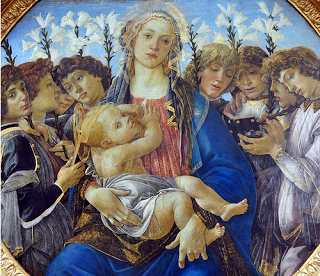
Botticelli’s Madonna with Singing Angels : (1478) tempera on board
The emphasis that Forsyth is placing on the artist being a Christian can be contrasted with the view expressed by Peter Fuller (an atheist) in Theoria (an accepted standard work setting out Ruskin’s views on art) that a work of art can have a ‘spiritual orientation, a spirituality
without God’.[xii] Whether or not this is really the view of Ruskin, who was a committed Christian, is debateable. However, this view does accord with that of the philosopher Jacques Maritain (1882-1973) who argues that ‘an artist is not called upon to love God or the world or humanity, but to love what he or she is doing.’[xiii]
Finally, in these general comments I would refer to the theologian and artist Paul Tillich.
Who was emphatic that Expressionism was the style that was best able to elucidate mankind’s relationship with the Ultimate Reality. Nevertheless naturalistic forms of art were also able to stimulate the religious experience as can be seen from his dramatic encounter with Botticelli’s Madonna with Singing Angels.
Gazing up at it, I felt a state of approaching ecstasy. In the beauty of the painting there was Beauty itself. It shone through the colours of the paint as the light of day shone through the stained-glass windows of a medieval Church … As I stood there, bathed in the beauty its painter had envisioned so long ago, something of the divine source of all things came through to me … That moment has affected my whole life … I compare it with what is usually called revelation in the language of religion.[xiv]
Clearly for Tillich, the encounter with this work of art created an experience in which he felt closer in his relationship with the Ultimate Reality and for him its power was such that it must have ranked on a level with the sacraments. Summarising this I suggest that the criteria or conducive properties required for a work of art be viewed as a sacrament are the intention of the artist, the content of the picture and the experiential effect on the viewer. It may be that not all these properties are required but I suggest that it is probable that at the very least one will be required if the work is to meet the overall requirement that the work will assist in mankind’s contemplation of his or her relationship with the Ultimate Reality.
Dr David Greenwood d.greenwood@uwtsd.ac.uk October 2020
[i] Otto, R. The Idea of the Holy. Oxford. OUP. 1958 p. 33-4. For a detailed description of each of these terms the reader is referred to pages 12 to 40.
[ii] Worship, as Evelyn Underhill writes is the ‘response of the creature to the Eternal…is rooted in ontology (Von Hügel)…(and) is an acknowledgement of Transcendence; that is of a Reality independent of the worshipper which is always more or less deeply coloured by mystery.’ For a full treatise on Worship, the reader is referred to Underhill, Evelyn Worship London Nisbet and Co. 1936 Chapters 1 to 9.
[iii] Ibid. p. 211.
[iv] Ibid. p. 211. In the religious context, transcendent suggests the idea of ‘something beyond’. There is: ‘a passing beyond all media in the approach to the Deity containing an effort to establish by a discipline of the intuitive faculty, direct intercourse between the soul and God.’ Gray, H.D. Emerson (thesis) Stanford (California) Stanford University Press 1917 (quoting from Conversations with Ralph Waldo Emerson by C.J. Woodbury p. 110) p. 9, note 9.
[v] Cupitt, D. Radicals and the Future of the Church London SCM 1989 p. 26 and Beckett, W. The Mystical Now: Art and the Sacred New York Universe 1993 p.1 (quoting Cupitt).
[vi] Belting, H. Likeness and Presence – A History of the Image before the Era of Art Chicago University of Chicago Press 1996 p. 7. (It is thought that Holy Images was first introduced by Edwyn Bevan in his book entitled Holy Images– London 1940- Belting p. 3.)
[vii] Maqcquarrie, J. 2004 p.105.
[viii] Bowker, J. p. 64. Here John Bowker is referring to a work by Holman Hunt.
[ix] Ibid. p.51.
[x] Ibid. p.51.
[xi] Forsyth, P. Christ on Parnassus – Lectures on Art, Ethic and Theology London Hodder and Stoughton 1911.
[xii] Fuller, P. Theoria – Art and the Absence of Grace London Chatto and Windus 1988. This particular quotation is taken from Pattison, G. Art, Modernity and Faith London SCM Press 1998 p. 73 It should be noted that Peter Fuller does not give a description of the God in which he professes an unbelief.
[xiii] Williams, R. Grace and Necessity – Reflections on Art and Love Harrisburg PA 17112 Morehouse 2005 p.15
[xiv] Pattison, G. quoting Tillich. p. 101. For an interesting paper on Tillich and Art and especially his reaction to the Botticelli Madonna and the Singing Angels see https://tsd.academia.edu/davidgreenwood and Tillich’s Theology of Culture and Art: Forming a Relationship to Healing Grace Submitted By: Michael T Santini (michaelsantini@comcast.net) Submitted To: Dr. Alejandro Garcia-River 2009 Graduate Theological Union. Michael Santini concludes his paper on Tillich with these words:
The calming beauty of Madonna and Child with Singing Angels brought Paul Tillich healing grace because the beauty was of an eternal quality. In encountering various creative art forms of culture, all peoples can experience the same transforming splendor. The impact of the art form to the individual can be in the religious, spiritual or theological dimension, and provide God’s healing grace in an uncomplicated and tranquil manner .… The key is in acknowledging the fundamental ability of the arts to become a source of grace through encounter.
 Brislington Community News