
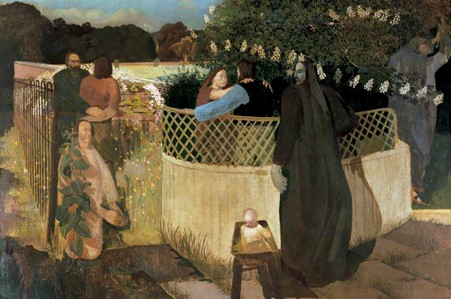
Oil on canvas – 40 X 69 inches
Stanley Spencer was a war artist during the First World War, before which he had studied under Henry Tonks at the Slade School at the time of many of the great British artists – Paul Nash, Mark Gertier and David Bomberg. The Nativity was painted whilst he was at the Slade and won the annual composition prize. At this stage in his life he was influenced by the Renaissance, the Pre-Raphaelites, as well as the French Impressionists, an influence which is shown in The Nativity. As Keith Bell writes: ‘Spencer drew on a variety of Renaissance sources, notably Piero della Francesca’s National Gallery Nativity, for the rather isolated Christ Child set in the open before a background of rustic architecture.’ One can also see the influences of Botticelli and Gauguin in this painting.
The two great influences in Spencer’s life were his home village of Cookham (he was given the nickname of Cookham at the Slade because he always went home every evening), and religion. His father was a church organist and his family had connections to both the Anglican and Methodist churches which possibly led to so many of his works being imbued with religious or spiritual overtones. In The Nativity we can sense a ’mysterious world out of time and clothed in grace, where every particular is touched with divinity’. This is very similar to the atmosphere in Zecharias and Elizabeth also set in a Cookham landscape. In The Nativity the setting is Mill Lane and the Water meadows adjacent to the Thames with the woods of Cliveden in the background (Hugh Kenner).
Looking at one or two aspects of the Nativity, we have already referred to the isolation of the infant Jesus, perhaps foretelling the future where crucifixion represents the ultimate forsakenness. As will be characteristic of many of Spencer’s later works Joseph and Mary are set merged in with a backdrop of trees so that they appear to be ordinary residents of Cookham. Joseph was modelled on one of the male models at the Slade.
The young couple to the left of the picture together with the kneeling figure could be said to be representative of the three wise men. Perhaps the kneeling figure is actually Spencer himself. We have an ethereal angel figure on the extreme right of the picture almost enclosed by the flowers on a symbolic horse chestnut tree which could be a reference to Christmas decorations or candles. But perhaps this figure is not an angel but is representative of Eve plucking the apple from the tree of knowledge and shown as an ethereal figure, symbolic of the passing of the old covenant about to be replaced by the new covenant represented by Jesus. And what about the black rather evil looking man in the centre of the picture almost overshadowing the infant. Is he perhaps an image of Herod? I do not think there is an agreed interpretation of this figure and it is left to the imagination of the viewer. It is a puzzle – what do you think? Perhaps the answer is buried somewhere in the Stanley Spencer archive in Cookham.
The art historians will notice the strong diagonals which infuse this painting, no doubt the main characteristic which led to its winning the composition prize. The very strong fence line (dividing public from private property) on the left disappearing towards infinity gives the painting a suggestion of transcendence. The bulky shapes of all the characters will become part of the style that will become associated with Spencer – a feature of his most famous painting produced at this time The Apple Gatherers.
From the little that I have said about this painting, it is clear that there are many ways of interpreting its various elements; so much is dependent on the viewer. Indeed, I have seen it written that it is the viewer, who collaborates with the artist in completing the painting.
References:
Bell, Keith. Stanley Spencer. London. Phaidon Press. 2008
From Websites: Tate Britain descriptions and Hugh Kenner
Dr David Greenwood d.greenwood@uwtsd.ac.uk
 Brislington Community News