
Reflection on Stanley Spencer’s The Resurrection, Cookham,
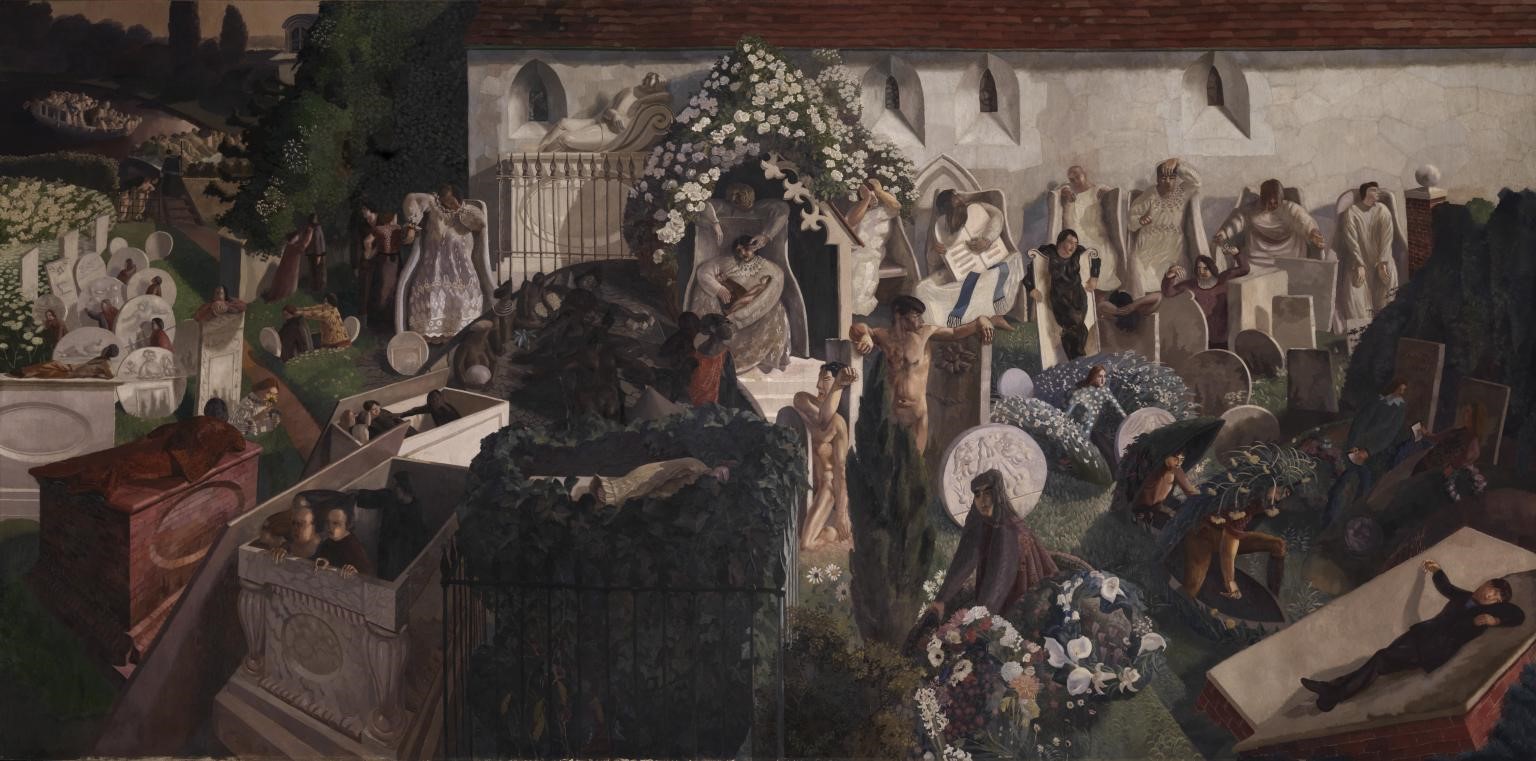
Oil on Canvas 274×549 cms. (1924-6)
Stanley Spencer (1891-1951) like the English landscape painter some 100 years before him, Samuel Palmer often set paintings with Biblical themes in their own locality – Shoreham in the case of Palmer, and Cookham for Spencer. In fact so loyal was Spencer to Cookham that the name of the small Thames side town became his nickname when he was studying at the Slade – he commuted home every evening rather than take lodgings near the College as most other students would do.
Another characteristic that Spencer had in common with Palmer is that many of his painting are regarded as ‘spiritual’. I have mentioned these characteristics before in other reflections but to summarise, I would suggest that:
1) Art reveals through the skill of the artist some aspect of a subject that would not be immediately apparent.
2) The artist’s depiction of an object makes a reference to the perceptual process of the viewer which enables an understanding to be achieved through, for example, the use of analogy.
3) The artist engages with the state of mind of the viewer to achieve an elevated or heightened emotional response to the work of art which may suggest a transcendence that lies behind the objects depicted.[i]
Transcendence or spirituality is something which we recognise almost subconsciously but often the exact feature of such a painting is that it indicates a great contrast between light and dark and often shows a great distance to the horizon.
Without any further introduction let me begin to examine The.Resurrection, Cookham. As always I suggest that reader examines the picture on line – the reproduction in a newsletter cannot hope to give a really good representation – in this particular case the picture is so huge that the artist had to stand on a box on a table (in someone else’s studio) to reach to the top of the picture. It is set in Cookham Churchyard and is said to have been inspired by Donne as being ‘the holy suburb of Heaven’[ii] The whole painting is showing its characters in a relaxed setting – some occurring more than once, enjoying the peaceful setting beside the Thames. In the centre of the picture below the floral arch is an image of God with Jesus below cradling a baby. To the left of God is a collection of prophets or saints, plus Moses, ranged alongside the church wall.
To the bottom right side of the picture is an image of Spencer lying on a tomb set out as an open book. Back in the centre of the picture are two naked figures – Spencer standing and his brother-in-law and fellow artist Richard Carline kneeling both ‘stilled by the wonder of it all are inactively thrilled’.[iii] Spencer’s wife Hilda occurs three times in the centre of the picture on an ivy covered tomb, smelling the flowers and in the left of the picture climbing over the fence to the Thames which is representing the River of Life. The group of black people is intended to give the painting a sense of universality. At this point I cannot do better than quote the artist himself:
No one is in any hurry in the painting. Here and there things slowly move off but in the main they resurrect to such a state of joy that they are content… to remain where they have resurrected. In this life we experience a kind of resurrection when a a state of awareness, a state of being in love, and at such times we like to do again what we have done many times in the past, because now we do it anew in Heaven[iv]
Having given this brief analysis can the characteristics of a transcendent painting be discerned. First the contrast between light and dark – this can be seen in the contrast between the lightness of the church wall and the darkness of the foliage and again in the contrast between the darkness of the trees alongside the Thames and the brightness of the golden fields beyond.
In this painting Spencer draws together the totality of his life as an artist to this date – setting all his friends and contacts, be they believers or not, in the churchyard at Cookham. There is just so much one could write about this painting that it will warrant a return visit, but for now let me leave you with some final words from Stanley Spencer himself. Mentioning the influence of John Donne who saw the resurrection in terms of the ‘particular’, meaning the immortality of the soul, and the ‘general’ concerned with the overall position that the faithful could achieve on earth corresponding to the Buddhist state of Nirvana. Spencer hoped to achieve a representation of both states in this picture. As he explained to W.G.Hall writing in the Leader in 1927, ‘He (Spencer) does not believe necessarily that the resurrection of the dead is a physical one. To him, the resurrection can come to any man (or woman) at any time, and consists in being aware of the real meaning of life and alive to its enormous possibilities.’[v] Later, writing in 1937 Spencer wrote ‘I have therefore thought that a great deal in this life was a key to the perfect life of heaven. And so feeling sure I could get these glimpses of what to one was heaven absorbed my attention and caused me to look at things in a special way… I know the proper place for everything…and I experienced a special exhilaration as I put this here and that there.’[vi] Quite clearly for Spencer the act of painting was a spiritual experience.
Dr David Greenwood d.greenwood@uwtsd.ac.uk March 2021
[i] Greenwood, David M. Art and Spiritual Experience Leominster Gracewing. 2019 p. xiii
[ii] Royal academy of Arts. Stanley Spencer RA. London. Weidenfeld and Nicholson 1980. P92a
[iii] Ibid quoting Carline. p.92a
[iv]bid quoting Spencer p.92
[v] Bell, Keith. Stanley Spencer. London. Phaidon Press. 1992. p. 59a
[vi] Ibid. p. 59b
 Brislington Community News