
A fortnight ago I investigated the question of whether or not an artist who had shown no outward evidence of religiosity could produce truly spiritual paintings capable of portraying for the susceptible viewer something of the numinous – suggesting what might lie beyond the veil. I took J.W.M.Turner as the artist and also discussed in brief detail the concept of the anonymous Christian as suggested by the theologian Karl Rahner. This week I will follow this by analysing the sacramental qualities of two late paintings of Turner: Shade and Darkness – the Evening of the Deluge (exhibited 1843) and Light and Colour (Goethe’s Theory) – the Morning after the Deluge – Moses Writing the Book of Genesis (exhibited 1843). For the purposes of considering their qualities as aids to religious contemplation, I will regard the two paintings (which were painted as a pair) as a diptych, and for simplicity I will refer to them as Shade and Darkness and Light and Colour. Both paintings are available in the Tate Collection and for a much better image can be viewed on line at www.tate.org.uk
These two pictures were painted as Turner was endeavouring to formulate a response to Goethe’s theory of colour (that colours come out of the interaction between light and darkness and were as a result of perception by the viewer).[i] However my concern is how these paintings might function in a church or chapel setting.
As J. Lindsay emphasises, one of the paintings shows Goethe’s negative colours whilst the morning picture shows the positive colours, expressing says Goethe ‘warmth and gladness’.[ii] In the Shade and Darkness painting we have the use of dark browns and reds surrounding a central area of white light painted in the form of a vortex. The eye is led into the vortex, perhaps emphasised by the birds, to which Turner refers in the poem, at the top of the picture. The eye is led so far into the depth that one might believe that Turner is endeavouring to show the physical world dissolving into a distant metaphysical realm. As Lindsay confirms ‘the dynamic colour elements … merge man and nature in the concrete sphere of immediate experience’.[iii] The painting is certainly an example of Turner’s depiction of the sublime, where the catastrophic forces of nature, perhaps in the form of a tsunami are shown with the utmost dramatic force.

JWM Turner: Shade and Darkness : Evening of the Deluge (1843) 787 x 781 mm oil on canvas
In Goethe’s terms the colours here ‘produce a restless, susceptible, anxious impression’, with the cold blue contrasting diagonally across the painting with the dark brown almost black, suggestive of absence of light before, in the corner of the picture there is just a lightening of the scene with a small area of shades of pale yellow. The effect of the darkness is to highlight the effect of the white vortex and add to the creation of the appearance of a tunnel preceding the movement through into the metaphysical world beyond.
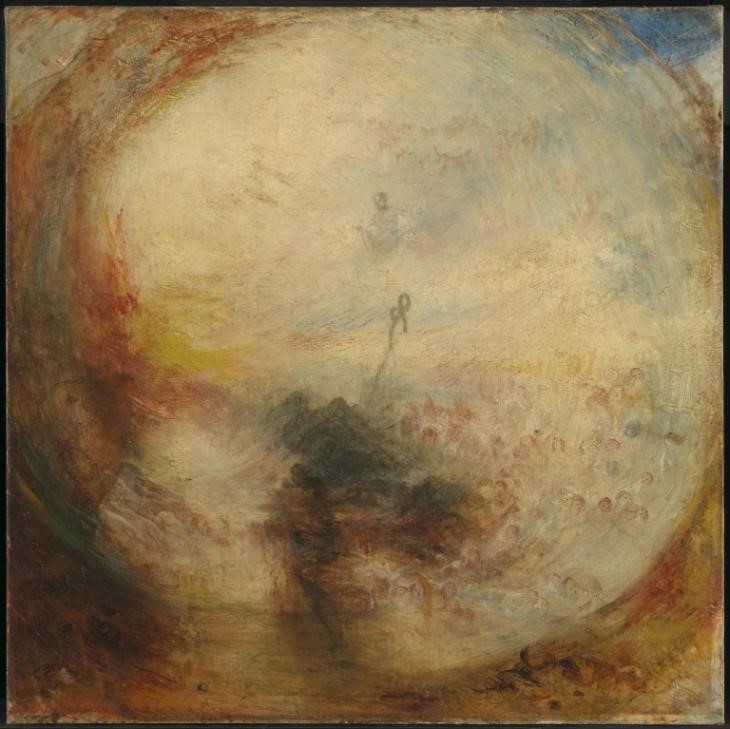
JWM Turner: Light and Colour (Goethe’s Theory) Morning after the Deluge Moses writing the book of Genesis (1843) 787 x 787 mm oil on canvas
In Light and Colour, Turner makes a reference to Moses writing the Book of Genesis which to the modern eye seems strange but at the time when Turner was working it was probably still the accepted view that Moses wrote parts of that book.[iv] The colour scheme here is positive with warm reds, orange and dark shades of yellow, with the only negative colour being reserved for the brazen serpent in the centre rising towards the back of Moses who is facing into the depths of the picture. The context of this part of the story is that at the end of the deluge a covenant was established between God and mankind such that if mankind looks after and nurtures the world then never again will God flood mankind out of existence. The sign of this covenant was the rainbow and why Turner chose not to include this phenomenon in the painting is an unanswered question, particularly intriguing when the splitting of light through a spectrum into the colours of the rainbow was an important feature of Newton’s theory of light. The nearest there is to the rainbow is the suggestion that the bubbles in the vortex surrounding the sun are themselves edged with the colours of the rainbow.
This prismatic effect is emphasised in the poem which accompanies this work:-
The ark stood firm on Ararat; th’ returning Sun
Exhaled earth’s humid bubbles, and emulous of light,
Reflected her lost forms, each in prismatic guise
Hope’s harbinger, ephemeral as the summer fly
Which rises, flits, expands, and dies.[v]
As with Shade and Darkness, Light and Colour has a very large central light, almost certainly the sun, with Moses sitting at the centre and writing, suggesting a calmness that is not present in the more obvious tunnel and vortex in the former work. The importance of the sun is emphasised in Turner’s poem by the use of the capital letter and is entirely consistent with Turner’s deathbed words ‘The Sun is God’ referred to earlier.
This reference to Turner as a follower of heliolatry mentioned previously, leads on now to consideration of whether or not these works of art could be regarded as sacraments. These pictures are both small (787 x 781 mm and 787 x 787 mm) and could be placed one on each side of an altar. They are both using the ‘simbolising power of colour to designate the Qualities of things’ and they are both tending towards the Abstract Sacred to which the radical theologian Don Cupitt refers in his book Radicals and the Future of the Church.[vi] These two paintings are both works that seem to proceed from the physical world and point to the metaphysical. They both utilise a prominent circle or vortex – a symbol for God according to Giotto (who when asked to draw a picture of God, drew a circle) and Pope Benedict XI. The use of the serpent symbol in Light and Colour, suggests either, the Fall of Man and the need for redemption or the alternative interpretation of the second Creation Story that on eating from the tree of knowledge Mankind has become sufficiently mature to leave the Garden of Eden and fend for him or herself. The caption to the picture in the Tate Gallery suggests that the brazen serpent is symbolising the cure from the plague and eventual salvation.[vii] (This is a reference to the passage in Exodus Chapter 4, verses 3-7, when after touching the serpent Moses is cured of leprosy – whether this was intended by Turner is conjecture.) Moses as the agent for the establishment of the moral code, the Decalogue, symbolises the need for men and women to worship God and to live in harmony with one another. In more general terms one could see in Shade and Darkness (located on the left of the altar) a metaphor for the wrath of God and in Light and Colour a metaphor for the glory of God. Alternatively, a typological application, placing the works in a New Testament context, one could see a metaphor for the Passion of Christ on the left, with the resurrection being suggested by Light and Colour.
So, in both pictures we have some of the most powerful themes of the three Abrahamic faiths – the fall of man, the need for redemption; the need for adherence to the law; death and resurrection. In addition to these themes of revelation, there is also the strong suggestion of Transcendence – moving through the vortex to something beyond in Shade and Darkness as well as being aware that there is something beyond the blinding light of the sun in Light and Colour. As Lindsay writes:
The summoned carrion birds flitter in out of the upper whirl: and we feel at once the blessing of the sun that shines on good and evil alike, and the curse of light upon man who has alienated himself from nature by his violence and corruption. The sun is both creator and destroyer. The painting is Turner’s final judgement on life and on death.[viii]
Werner Hofmann writing as part of an analysis of Light and Colour highlights the particular talent of Turner when he states: ‘In Turner’s liquefaction, the artistic subject – the testing and mixing of colour – is balanced by cosmogonic claims: the artist relates and gives new meaning to both the Creation as well as the dissolution of the world.’
In my view these two paintings assist in mankind’s contemplation of his or her relationship with nature. If we then accept that nature is God’s creation and think in terms of the Natural Theology that was both prevalent at the time of the Romantic period and is still current today, somewhat in the guise of Green Theology, then we are able to say that the contemplation of these works of art (by viewers susceptible to the visual imagery) would assist in bringing us closer to that Ultimate Reality. In other words these two paintings of Turner fulfil the criteria required to enable them to be dedicated or consecrated for use in the worship of that ultimate reality that is called God
[i] An explanation of Goethe’s Colour Theory is beyond the scope of this paper, but essentially, whilst Newton in his study of optics described light in terms of the wavelength produced when light strikes an object, Goethe was much more concerned with the relationship between the object and its perception by the viewer. The following is extracted from the website referred to below: ‘Goethe realizes that the sensations of colour reaching our brain are also shaped by our perception — by the mechanics of human vision and by the way our brains process information. Therefore, according to Goethe, what we see of an object depends upon the object, the lighting and our perception. Goethe seeks to derive laws of colour harmony, ways of characterizing physiological colours (how colours affect us) and subjective visual phenomena in general. Goethe studies after-images, coloured shadows and complementary colours.’ (Taken from website: www.webexhibits.org/colorart/ch.html )
[ii] J. Lindsay, J.M.W.Turner His Life and Work. London. Cory, Adams and Mackay. 1966. quoting Goethe, p. 212.
[iii] Ibid. p. 21.
[iv] The narrative of the flood has now been shown from Old Testament scholarship to consist of a combination of the P (Priestly) and J (Yahwist) traditions and not written by Moses. Much of this research was undertaken between 1850 and 1880, with Wellhausen being the prominent scholar in this area.
[v] Lindsay, quoting Turner, p. 212 – Fallacies of Hope.
[vi] Ibid. p. 212. Cupitt, D. Radicals and the Future of the Church London SCM Press 1989 p. 26.
[vii] The display caption in Tate Britain reads: Pair to ‘Shade and Darkness – The Evening of the Deluge’. This triumphant explosion of light brilliantly exploits the warm side of the spectrum. It celebrates God’s Covenant with Man after the Flood. The serpent in the centre represents the brazen serpent raised by Moses in the wilderness as a cure for plague. Here it symbolises Christ’s redemption of Man in the New Covenant. Turner’s verses rather undermine the optimism of the religious message by emphasising the transience of the natural phenomena engendered by the ‘returning sun’. http://www.tate.org.uk/art/artworks/turner-light-and-colour-goethes-theory-the-morning-after-the-deluge-moses-writing-the-book-n00532
[viii] Lindsay,J. p. 213.
 Brislington Community News