
(N.B. Better images will be found on website: Samuel Palmer – images)
A fortnight ago when writing about my understanding of the expression ‘seeing beyond the veil’ I concluded with some remarks about Samuel Palmer and referred to the Lonely Tower (1879), a work which was produced towards the end of his life. In this engraving he suggests the limitlessness of the numinous in the way in which he combines the idea of a veil with the infinite immensity of the night. This week I will look at this engraving in some detail and describe the context in which came back to producing works which point to the transcendent, after a period of producing works which though brilliantly executed did not have that spiritual quality.
After 1860 and the personal tragedy of the loss of his son, Thomas More, Palmer became a rather solitary figure and his work begun to express a deeper vision – but a different vision from his Blake/Shoreham period. ‘In the place of ecstasy and enthusiasm there was a more careful, meditative and richly laboured work’.[1]
Three significant events occurred at the time which probably contributed to this return to visionary or more overtly transcendent art. First, with the death of Blake’s first biographer, Alexander Gilchrist, Palmer was involved in corresponding with Mrs. Gilchrist not only in empathising with regard to grief and mourning, but also in helping with the completion of the Blake biography, although in connection with this, Dante Gabriel Rossetti (1828-1882) was the greater contributor. Secondly, he received a commission from Leonard Valpy to produce drawings to illustrate Milton’s Il Penseroso (the contemplative Man) and L’Allegro (the Cheerful Man)[2]. Thirdly, while living at Redhill, his final residence, he had many discussions with a clerical family the Wrights, one of whose sons became a Prebendary at Hereford Cathedral. Whilst they did not frequently discuss art, they did discuss theology and morals.[3]

The Lonely Tower (1879) 36.3 × 50 cm Etching
Il Penseroso is an ‘invocation to the goddess Melancholy, bidding her bring Peace, Quiet, Leisure and Contemplation. It describes the pleasures of the studious meditative life, of tragedy, epic poetry, and music. L’Allegro is an invocation to the goddess Mirth to allow the poet to live with her, first amid the delights of pastoral scenes, then amid those of ‘towered cities’ and the ‘busy hum of men’.[4] (It is said that Il Penseroso influenced the ‘graveyard poets’, one of whom was Edward Young whose extract from Paraphrase of Job had, as mentioned previously, such an impact on the four year old Palmer.) This incident with the shadow was of such significance in the work of Palmer that writing to Frederick Stephens (1818-1907) (Pre-Raphaelite Brotherhood founder member and art critic) in 1871 he quotes the famous couplet and then writes ‘I never forgot those shadows, and I am often trying to paint them.’[5]
Palmer produced eight watercolours for these two works and became so obsessed by them that, like his early visionary works they were financially very unrewarding. As Lister remarks after some fifteen years after the awarding of the commission, ‘the finest fruits of the venture were a couple of etchings, suggested by the watercolours, The Bellman and the Lonely Tower, the latter being Palmer’s masterpiece in this medium.’[6]
Later in his biography of Palmer, Lister refers to the Lonely Tower as ‘one of the greatest works ever made in this medium by an English artist.’[7] This view is corroborated by Vaughan who quoted Yeats’s (1865-1939) view of Palmer that ‘The lonely light that Samuel Palmer engraved/An image of mysterious wisdom won by toil’[8]
The theme of the lonely tower occurs in at least two watercolours, the first (51cm x 70.5 cm) with a slightly different arrangement of landscape and figures being produced in 1867-68, and the second much smaller (16.5 x 23.5 cm) with an identical arrangement of figures as the etching, being produced later and probably just after the etching.[9]
In the etching, there is the crescent moon low down in the centre of the picture, with the lonely tower lit from within through one window, located on a high bank to the left of the etching. On the right hand side of the picture is a flock of sheep overlooked by a reclining couple gazing at the tower which is surrounded by the stars of Ursa Major, whilst on the left there is a wagoner with his ox cart negotiating a narrow stone-built pathway on the edge of a chasm which separates the roadway from the hill on which the tower has been built. Trees to the right of the picture and one tree in the foreground complete the composition.
The Lonely Tower (painting)
The water colour (shown in 1868) on which this etching is based was accompanied in the exhibition by a quotation – this time not from the Bible but from Il Penseroso (Thinking Man) by John Milton. In this narrative poem set in his mind, Milton embraces the goddess Melancholy and asks her to take him on a journey where he may find peace and quiet and the opportunity for contemplation. The extract from the poem with which Palmer annotated this painting is:
Or let my lamp at midnight hour,
be seen in some high lonely tower,
Where I may oft outwatch the Bear,
with thrice great Hermes.[10]
Edward Cummins interprets this passage as meaning: ‘There, he would contemplate the constellation known as Ursa Major (commonly called the Bear or the Plough) or consider the profound views of Plato. There he might also reflect on a great tragedy, such as that which befell Troy or that which was enacted on the stages of ancient Greece.’[11] This is the background, also, to a number of other paintings produced at this time (for example The Prospect (1881), and The Bellman (before 1881)) all based around Milton’s poem. One can perhaps assume that Palmer was contemplating the end of his own life at this time which may explain why he has returned to the style that he departed from at the time of his marriage and very close relationship with his father-in-law John Linnell.
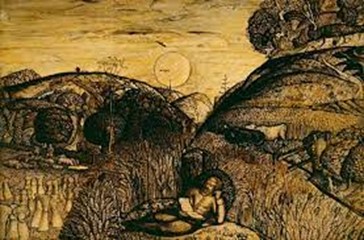
The Valley Thick with Corn. (Available to view in Ashmolian Museum Oxford)
As with The Valley Thick with Corn the moon features strongly being shown symbolically (because it is below the line of the horizon in the painting based on the etching) in the middle distance, and in the right hand foreground there is a shepherd and (presumably) his wife or lover contemplating the scene and looking towards the tower. On the left hand side there is a bullock cart being led homeward along a stone-flanked road leading upwards and out of the picture. As the eye is taken upwards along this lane it is turned inwards towards the tower itself with a very bright line burning within. The prominent stone wall on the left is balanced by the hay rack on the right and the tower on the left by the prominent group of trees on the right. In the immediate centre foreground there is a stream visible below the stone walling which is flowing into the valley in the middle distance and then away into the very far distance beyond the moon. In the centre of the painting there is a rather short (and hence symbolic) length of fencing preventing the sheep falling into the stream below. The hill which is surmounted by the tower forms a diagonal which leads the eye down towards the sheep lying at the base of the group of trees. Many stars are shown shining quite brightly suggesting that is it quite late in the evening, although this is not consistent with the bright light coming from behind the viewer and illuminating the backs of the lying sheep and particularly the white shirt of the shepherd’s companion. The constellation Great Bear (Ursa Major) is shown prominently picking up the reference in the extract from Il Penseroso. Finally mention should be made of the Palmer bird – presumably an owl – to the left of the centre foreground. Some commentators have suggested that the Tower is the tower located on the top of Leith Hill in Surrey which is very close to the farm where his son Thomas Palmer is buried. This, of course, fits with the overall theme of melancholy, death and resurrection.[12]
There does not appear to be any distortion in the perspective with the foreground figures and receding sheep all shown to their correct scale. As with The Valley Thick with Corn there is the impression of a tremendous distance to the far horizon – an effect emphasised by placing the bottom of the moon below the line of the horizon. If one assumes that the moon is the symbol for Christ (or Mary) then the positioning of the moon suggests that the Savour is coming towards the painter –maybe an allegorical rendering of the resurrection. The message here is that Palmer is contemplating a distance far beyond the moon, possibly even a world beyond death, Palmer’s vision of heaven. The brightly lit tower is surrounded by sky and replaces the church steeple shown in a number of other Palmer paintings, a feature in the painting that takes the eye upwards perhaps in contemplation of heaven.
Aerial perspective is apparent, particularly emphasising the far distant horizon and encouraging contemplation of the world beyond. The clarity of the foreground is contrasted with the mistiness of the distant horizon, but the tower which is some distance away from the foreground is also shown in sharp focus, confirming the importance Palmer is attaching to the significance of that tower. The use of very dark shadow gives rise to a sense of mystery, but the light brings particular attention to the crescent moon, the distant horizon and the light in the tower. The foreground is sharply in focus and quite bright with the source of this light being unexplained. Examining the shadows in the painting in more detail, inconsistency is apparent; for example the shepherd’s back is in deep shadow when with the same angle the nearside edge of the hay rack and the stone wall are very clearly lit from this unknown source of light. Palmer, one can only assume, is using this light to draw particular attention to those parts of the painting he wishes to emphasise – those parts which point towards the Transcendent, namely the moon, the tower, the wall leading to the infinity beyond edge of the painting and the infinity of the universe beyond the Great Bear.
While the colour range of the painting is greater than that of the Valley Thick with Corn – the palette is still limited with the overall effect being sepia. The other main colour is the blue of the sky which is reflected in the stream and the accoutrements of the shepherd and his companion. These dark colours are then contrasted with the bright white on the moon, the shirt of the companion and the bullock being led out of the picture. In the etching the deep shadows are emphasised but the unknown light coming from behind the viewer adds a symbolic mystery to the picture.
The overall theme of the painting and the etching is contemplation – of life and death, of the firmament and of resurrection. The quotation from Il Penseroso points the viewer in this direction, reinforced by the special effects discussed above. The positioning of the moon gives it tremendous importance and the lighting-effects all contribute to a sense of transcendence. The use of young people adds a more positive outlook to what could otherwise be a rather melancholy picture. The eye is taken into three directions – upwards towards the sky, to the left with the roadway, and outwards into the distance beyond the moon – and this constant looking outwards and beyond is the main characteristic pointing to the transcendent.

The Bellman
At the end of his life Palmer had returned to the visionary work of his youth – perhaps not with the same energy but with a more mature, considered expression of his vision as can be seen in the Lonely Tower and in his other Milton etching The Bellman – a mature depiction of Shoreham and its countryside conflated with the Land of Beulah. In writing to fellow artist Philip Gilbert Hamerton (1834-1894), Palmer wrote of The Bellman ‘It is a breaking out of village fever long after contact – a dream of that genuine village where I lost, as some would say, seven years of musing over many strings, designing what nobody would care for, and contracting among good books, a fastidious and unpopular taste’.[13]
To the end of his life, Palmer maintained that intention always to reflect the Glory of God’s creation in his work – to provide works of inspiration for contemplation. His God- given talent was his ability to draw, to paint and, at the end of his life, to etch. That his extraordinary ability to depict his visionary outlook was not recognised during his lifetime was disappointing and for him rather disheartening, but he did not allow this lack of recognition to detract him from his purpose.
As Cecil points out:
To respond to life was, for him, to respond to God as the author of life. This meant that religious experience was the mainspring of his creative vitality … His faith was strengthened by the habit of religious practice. He recognised this and drew his conclusions. Palmer was a religious existentialist before his time, who discovered that the best way to maintain his faith was to act on it.[14]
In conclusion one can surely say that the words which Palmer applied to Claude apply equally well to Palmer himself: he should be considered the ‘genius, equally tender and sublime, who re-opened upon canvas the vistas of Eden.’[15]
Dr David Greenwood d.greenwood@uwtsd.ac.uk March 2022
[1] Vaughan, William Samuel Palmer – Vision and Landscape. London British Museum Press 2005 p. 224a.
[2] http://www.yorku.ca/jprs/pdf/Allan_Life_with_Page_Life_28.pdf. For details of the commissioning by Valpy.
[3] Lister, Raymond Samuel Palmer – a Biography London Faber and Faber 1974 pp. 257-8.
[4] Drabble, Margaret (ed) Oxford Companion to English Literature. Oxford. OUP 1985 pp. 492a and 545a
[5] Abley, Mark The Parting Light. Manchester. Carcanet Press. 1985. p. 220.
[6] Lister, Raymond Samuel Palmer – a Biography London. Faber and Faber 1974. p. 266.
[7] Ibid. page 273
[8] Vaughan, W. quoting from W.B.Yeats The Phases of the Moon, (1919) p. 224a
[9] Ibid. p. 233c.
[10] Ibid. p. 232a.
[11] Cummins, Michael J. Study Guide to Milton’s poem Il Peneroso available on line: http://www.cummingsstudyguides.net/Guides8/Penseroso.html .
[12] Vaughan,W. Barker, E.E.,and Harrison, C. Samuel Palmer 1805-1881 – Vision and Landscape London British Museum Press 2007 p.232.
[13] Abley, Mark p. 230.
[14] Cecil, David. Visionary and Dreamer Princeton. Princeton University Press 1969 p. 90.
[15] Ibid. page 90.
 Brislington Community News