
The word sacrament is imbued with a number of meanings – an ecclesiological term, a term within the discipline of natural theology, a term of signification and an oath or pledge. In this reflection these terms will be analysed in terms of whether or not a work of art could be likened to the sacred or be regarded as a sacrament.
First of all and dealing with the ecclesiological term, the Church is an organisation which on the one hand is concerned with celebrating divine action in the world – God’s revelation and grace – and on the other fulfilling a community or social function. Services of worship can be of many different forms and held in many different places but generally in each service there is a reading from Scripture (the Word) and in some there is a celebration of Holy Communion (the Eucharist). Within this context the sacraments are signs of grace –‘ritual acts which both express and bring about a spiritual reality’.[i] Expressed another way, the sacraments help to enable that Ultimate Reality called God to be become manifest in human beings – ‘the growing points…at which the divine grace sanctifies the Church and conforms its life to Christ’.[ii]
In formal ecclesiastical terms there are seven sacraments; two primary sacraments that are said to have come directly from Christ – Baptism and the Eucharist, and five lesser sacraments. The five lesser sacraments are confirmation, marriage, ordination, penance or sacramental confession and unction or healing with oils. So, strictly, within this precise category, a work of art cannot be regarded as a sacrament.
If, however, we examine the origin and derivation of sacrament then there is at least a discussion to be sustained. The Latin word sacramentum which originally meant oath was introduced into theological use by the early Latin Church fathers where its meaning became changed from entry into military service to entry into a mystery religion. The Greek Church fathers used the Greek equivalent of the word – mysterion, secret. The first recorded church uses are by Tertullian (sacramentum) and Gregory of Nyassa (mysterion) who employed the term when initiating believers into the Church with the rite known as Baptism. Other Church fathers also used the word sacramentum to suggest a sign, or that which signifies, and eventually it became applied to the Eucharist and the Incarnation. Thereafter the sacraments became more closely defined with Peter Lombard (c. 1095-1169) listing the seven sacraments in a summary of doctrine which became accepted as standard. Thomas Aquinas’s (1225-1274) Summa Theologica left the definition of the sacrament unchanged. This restricted definition of the sacraments persisted until the twentieth century, when a major contribution from the Second Vatican Council (Lumen Gentium) stated that the Church itself is in the ‘nature of a sacrament, “a sign and instrument, that is of communion with God and of unity among all men”’.[iii]
Setting aside this strictly ecclesiological meaning, within the discipline of natural theology there is an even broader approach to the use of the word sacrament, a meaning which was developed by Archbishop William Temple (1881-1944) in his Gifford Lectures of 1932 and 1934.[iv] In these lectures Temple promoted the concept of a sacramental universe which John Macquarrie links to a definition in the Anglican catechism where a sacrament is said to be ‘an outward and visible sign of an inward and spiritual grace given unto us, ordained by Christ himself, as a means whereby we receive the same, and a pledge to assure us thereof’.[v] By the use of the words ‘inward and outward’ we have here the suggestion of both God’s immanence and transcendence. It was, Temple said, in things of this world that the reality of God was revealed, ultimately in the incarnation of Jesus Christ in human flesh, but also in the Scriptures and in the Church. Materiality was not the initiative of humans but the initiative of God. For Temple, the material was given a place of respect since it was created and used by God. All this affirms the idea that we live in a sacramental universe. Earlier Anglican thinkers had said much the same thing. George Herbert, a priest and poet (1593-1633), had spoken of this sacramental principle in one of his well-known hymns. Herbert urges us to sing:
Teach me my God and King
in all things thee to see.
Herbert is here expressing a sacramentality which suggests that God is to be found and seen in all ‘things’, including the material things of this world. Very appositely, Temple uses the analogy of an artist when referring to the creative power of God, comparing the relationship of God to the world with the relationship of an artist to his or her work of art. Macquarrie emphasises the relevance of this analogy and in so doing comes close to defining immanence:
The artist certainly transcends his work, for it is the artist who created it. But the artist is bound to the work so created and has poured something of his or her self into it so that from the work or through the work we can have a relation to the artist. Something of the artist is present in the work and revealed in the work. Clearly, the artist is not identical with the work or a mere aspect of the work, just as God is not identical with the world or a property of the world-process…as Thomas Aquinas expressed it ‘God exists in all things by presence, power and substance’.[vi]
This viewpoint was also expressed by John Keble (1792-1866) – a believer in nature-mysticism and joint founder of the Oxford Movement – who wrote poetry to suggest the idea that God is to be found not only in ‘the depths of the human soul (as in Augustine, Teresa and John of the Cross to name three examples) but in the natural world.[vii] A short extract from one his poems reads:
The works of God, above, below,
Within us and around,
Are pages in that book, to show
How God himself is found.[viii]
In summarising Keble’s mysticism, Macquarrie writes:
If there is a word which best describes Keble’s mysticism it is, I think, the word ‘sacramental.’ For him, the whole creation was a sacramental world. The material creation is not to be despised, for matter too belongs to God and owes its existence to God: it can be a vehicle for God’s presence. In this matter, we can see Keble in the spiritual line of John of Damascus, who defended the icons against their detractors.[ix]
If this argument is accepted, then all works of art have the potentiality of becoming sacramental, the question then remaining being that of the achievement of that potentiality. One needs to be careful to distinguish between the idea that everything in the world is a sacrament and those artefacts through which we can begin to have some appreciation of God’s presence leading to the third meaning of sacrament expressed in the first paragraph of this reflection – a term of signification or signposting. I have previously written of how artists have given a suggestion of that which lies beyond the veil – signifying that ‘outward and visible sign of an inward and spiritual grace’ referred to by Macquarrie above.
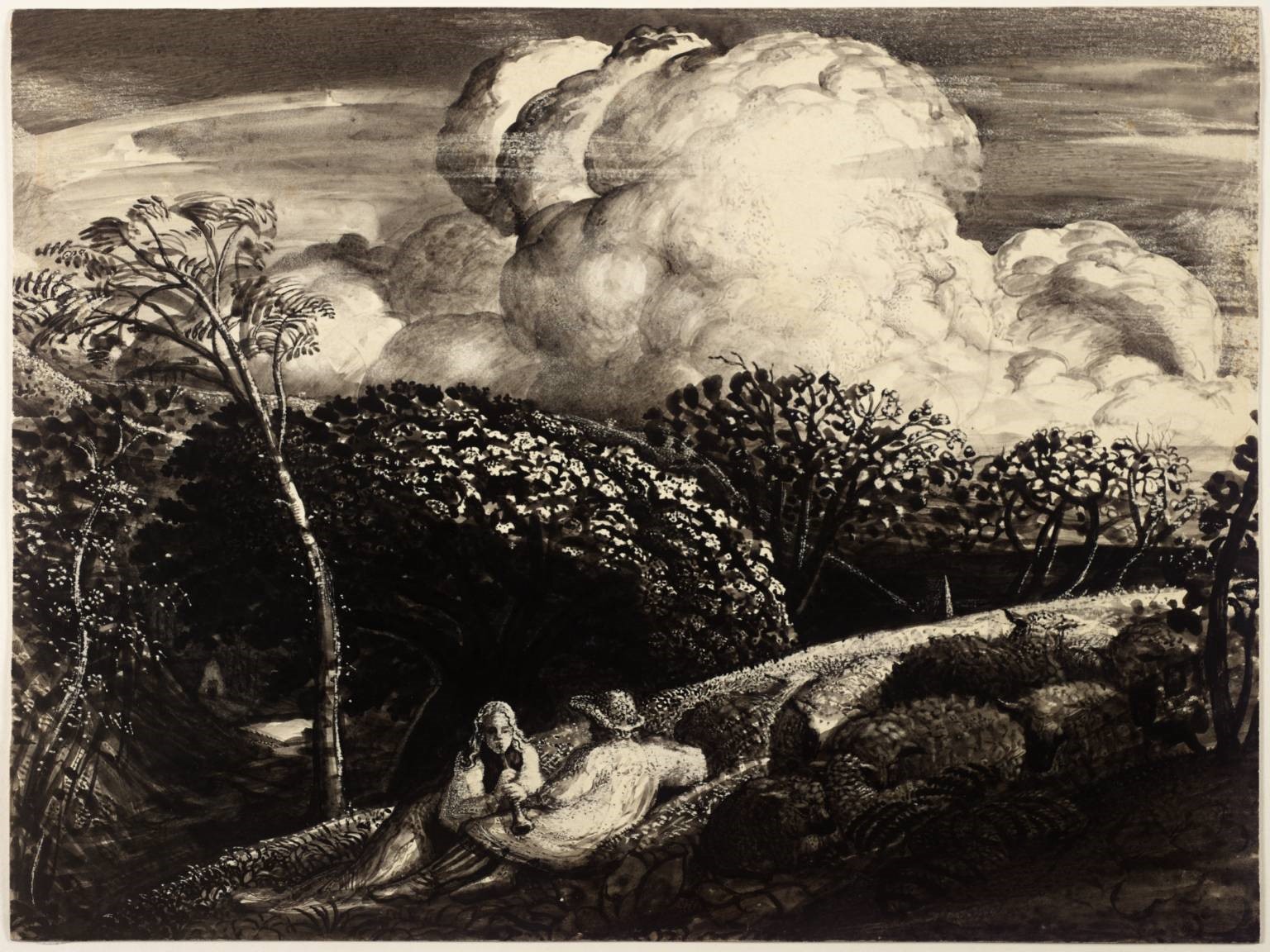
Palmer The Bright Cloud (c 1833-4) ink and watercolour on paper
In some cases such as Palmer’s The Bright Cloud (1833-4) the artist could be described as presenting the viewer with a vision of one of the traditional theophanies (manifestation or appearance of a deity to mankind) described in the Bible – Exodus, Chapter 24, verse 15 ‘…he called to Moses out of the midst of the cloud.’ There are, of course other traditional theophanies described in the Bible which are clearly intended to demonstrate the presence of God – for example, the pillar of fire (Exodus, Chapter 14, verse 24) and these have been portrayed in art
The contributions from Temple and Macquarrie enable a wider interpretation to be granted to discussion of the sacrament. Suffice to say at this stage that the relationship is between the artist and the viewer in much the same way as the relationship is between the priest and the communicant in the service of the Eucharist.
To examine this thought further, a church service will normally be conducted by a minister using a particular form of liturgy. Liturgy is difficult to define but a good description is that of J.D.Crichton:
Liturgy is the communal celebration by the Church, which is Christ’s body and in which he with the Holy Spirit is active, of the paschal mystery. Through this celebration, which is by nature sacramental, Christ, the high priest of the community, makes present and available to men and women of today the reality of his salvation.[x]
In general, a liturgy consists of both the ministry of the word and the sacraments and the relationship between these two aspects of a service is extremely important. In both Protestant and Catholic worship the two are considered essential and complementary. A Belgian Catholic theologian who has written widely on the subject of the sacraments, Edward Schillebeeckx (1914-2009) stated:
At its peak the word itself becomes sacrament … Because the sacrament is entirely fruitful only in the one who receives by faith the gift which Christ makes of himself in the sacrament, the ministry of the word (whose internal effect is the obedience in faith to the salvation brought to us by God in Christ) is necessarily directed towards the ministry of the Sacrament. What is begun in the word is perfected in the sacrament.[xi]
Until relatively recently, Protestant worship, in addition to accepting a much wider variation of the liturgy compared with the Catholic, gave more prominence to the word inasmuch as communion services were held less frequently than services of the word alone (for example, Matins or Evensong).[xii] However in the last 30 years or so the Eucharistic service has come into prominence with the dual proclamation of God’s presence being given in the two forms of ‘preached and signified’
This revised approach to worship and the sacraments enables greater flexibility to be adopted in the definition of sacrament and, in addition to the seven formal sacraments to which reference has been made above, alternatives can be considered, providing that they have the essential defining factor of assisting in communicating the ultimate spiritual reality. Looking at this another way the essential feature common to all sacraments is that they assist in making that link between the Ultimate Reality and the human being. This duality is shown most clearly in the Eucharist where there is a genuine re-presenting by the celebrant of Christ’s work which has an effect on the participant which is individual to that participant and usually has an element of mystery. But this is only one way in which the relationship between mankind and God can be maintained, and following the concept of sacramental universe the possibility remains of establishing that relationship in a myriad other ways, including ways beyond the confines of church authority.
So the question concerning a work of art and the sacraments, need not be concerned with whether or not such a work fits into one of the seven formal definitions given above, but can be rephrased in other ways as follows. In this more general approach the sacrament could be regarded as enabling the presence of God to be perceived, with that perception being established through a work of art that would be acting rather like a conduit, permitting the viewer or communicant a sense of the spiritual realm that lies beyond the veil.
Dr David Greenwood d.greenwood@uwtsd.ac.uk October 2020
[i] For a good summary of the development of the definitions of sacraments see: Crim, Keith (ed) The Perennial Dictionary of World Religions San Francisco Harper and Row 1989. For this particular quotation see p. 636 a.
[ii] Macquarrie, J. Principles of Christian Theology London SCM Press 1966 p. 364
[iii] Crim, K. The Perennial Dictionary of World Religions Harper and Row 1989 p. 636 b.
[iv] These lectures were written up in Nature Man and God by William Temple, published in London by Macmillan in 1940.
The idea that we live in a sacramental universe has been expressed by many Anglican thinkers, especially in their reflection on the sacraments as we use them in our liturgical life. Archbishop William Temple expressed this view in his Gifford Lectures of 1932-3 and 1933-4. Temple argued that ‘Christianity is the most avowedly materialistic of all the great religions’ (p. 478). By this he meant that the goodness of creation and the idea of a sacramental universe was God’s chosen way and not that Christians were merely addicted to material things.
http://www.anglicancg.org.au/articles.php/21/do-we-live-in-a-sacramental-universe
[v] Macquarrie, J. A Guide to the Sacraments London SCM Press 1997 p.4.
[vi] Ibid. p. 8.
[vii] Macquarrie Two Worlds are Ours – An introduction to Christian Mysticism London SCM Press 2004 p. 217.
[viii] Ibid. p. 220.
[ix] Ibid. pp. 222-3.
[x] From an essay by J.D.Crichton in Jones,C., Wainwright,G. et al. The Study of Liturgy London SPCK and New York Oxford Unversity Press 1992 p. 28.
[xi] Ibid. p. 38 (Essay by Carol M.Norén quoting Schillebeeckx)
[xii] This emphasis given to the word in protestant services can be traced back to an error in a development from John Calvin, whose intention was always to regard the word and sacrament as complimentary, but actually referred to the sacraments as verbum visible thus giving rise to the prominence of preaching in Protestant services. For a more detailed description of this see Macquarrie, J. (Principles … ) pp. 399-400 and many other references.
 Brislington Community News