
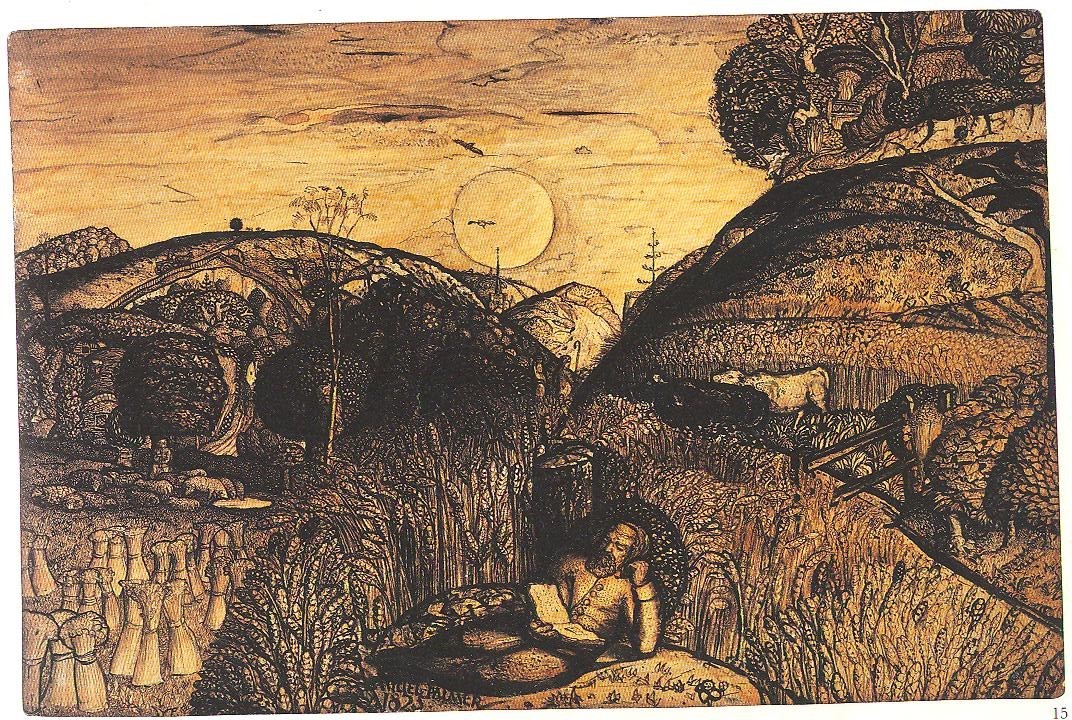
 Valley Thick with Corn (1825) 18.4 2 × 7.5 cm Dark Brown ink and Sepia mixed with Gum (A better image could be obtained on your tablet or laptop.)
Many of you will know that my researches and indeed my book have been concerned with the way in which the spiritual has been represented by visual culture. One of the most renowned artists working in the genre was Samuel Palmer (1805-81) and in my reflection today I will examine one of the six sepia paintings which are regarded as amongst the most spiritual of Palmer’s works.
As occurs with a number of Palmer’s spiritual works this small painting is annotated with a biblical extract; this is one of the traditional ‘harvest’ psalms – no.65. ‘Thou crownest the year with thy goodness…’
In the immediate foreground there is a figure reading (or at least contemplating the book as the light comes only from the rather exaggerated moon) connected vertically above the reader by the stems of the remaining standing corn leading the eye to the church the steeple of which points to the (harvest) moon. So far as the identity of the reader is concerned there has been much speculation – some suggest it is Palmer himself with a copy of the Bible, another school of thought suggests that he is Bunyan reading Pilgrim’s Progress and because we are aware of of Palmer’s interest in that work the suggestion of Bunyan is not unreasonable. Others have speculated that he is a Shakespearian character or even Shakespeare himself.72
This is speculation and many hills are shown, any of which could be the Delectable
Mountains overlooking Bunyan’s Beulah. To the left of the figure above the stooks of corn there is a shepherd (an allusion to Christ the good shepherd, as exemplified particularly in Psalm 23) watching over his flock, beyond which there is there is a wooded area and, in the far distance, a horse and cart presumably returning to the farm. The road beyond the cart disappears over the brow of a hill beyond which there is another wooded hill: overall there is a suggestion of tremendous distance which is reflected also on the right hand side of the painting where there is a road leading to a high cliff which takes the eye though a bridge, a wood and out of the picture. Returning to the centre of the picture there are two farmworkers pausing to look at the cattle on their way back to the village, represented solely by the church the steeple of which, as mentioned above, leads the eye upwards to the moon and the sepia sky with its hovering birds, which following a reference to Palmer’s sketch book could be owls.
In this particular work there is religious or spiritual significance and the influence of Blake, for the reclining figure is shown in a pose which is often used to depict melancholia. While there cannot be a definitive answer to the identity of the book which is being read, perhaps there is further evidence in support of the Bible from Palmer’s 1824 sketch book. where in a small sketch quite clearly the book being read is the Bible, and there is, also reference to Psalm 65 in a sketch of the harvest moon with reclining people and the open Bible with the extract from that psalm visible.
The enthusiastic nature of religious experience is clearly evident in Palmer and he is surely endeavouring to overcome the difficulty of validating that conviction through his presentation of such scenes as this. To examine the picture in more detail, the composition creates an impression of a tremendous expanse (meeting one of Rudolf Otto’s criteria for a work of art depicting transcendence) encouraging the viewer to contemplate the far distance as well as the bounty provided by the God created world; Palmer depicts the real world of Shoreham (Kent) as well as the biblical promised land. The approach to the perspective is accurate, with the church steeple and the receding hills all shown in their correct relationship. The only obvious distortions are for the birds which are not directly overhead but shown to be in the distance but rather large for that distance, and the exaggerated moon. The moon in reality always appears to be large when close to the horizon where it is seen in relative close proximity to trees and buildings, but even taking this into account Palmer is making a point to emphasise the importance of the moon, possibly intending it to be a symbol of Christ (or Mother of Christ), an intention made even clearer by the ploy of highlighting it with the steeple. So, by the use of perspective Palmer is highlighting Christ or Mary and linking this image to the infinite-beyond as suggested by the vast panorama which can be inferred from the visible tops of the hills receding into the distance, perhaps the ‘moony habitations of (Bunyan’s) Beulah’.
The use of light and dark is interesting inasmuch as the moon has been given prominence but there is obviously still much light coming from the setting sun. The light from the sun is clearly shining on the stooks, the front of the person reading, the book, the hill in the central background and the white cow. It is obviously late in the evening because work has stopped and the people are going home (during harvest time this would not happen at the end of the afternoon or early evening) and I doubt that in reality there would be as much light as Palmer has suggested. This tactic certainly leads to a very strong contrast with the deep shadow which suggests mystery or, perhaps, shows that the artist discerns mysticism within the scene that he depicts. This contrast is, of course, another characteristic which has been highlighted by Otto as indicative of the endeavour to portray the numinous.
Palmer has used dark brown ink and sepia mixed with gum arabic. As well as enhancing the air of mystery or even mysticism, this medium when the picture itself is viewed (rather than as a print in a book or on the screen) has a solidity, and a three dimensional quality which enhances the perspective discussed above. This three dimensional quality almost suggests that the ink and sepia has been applied to a shallow ivory carving of the scene.
In summary, The Valley Thick with Corn achieves the objective of pointing to the Transcendent, not through the size of the work but with subtlety through its representation of the mystical through symbolism, particularly the church steeple pointing to the moon. The abundance of God’s creation is represented by the harvest scene itself aided by the inscription from Psalm 65. Thoughts of ‘what lies beyond?’ are induced by the use of perspective and the far distant hills. The reading figure suggests contemplation – the book is not known but both the Bible and Pilgrim’s Progress would be consistent with the interpretation that this is a work of art that points towards the Transcendent. The painting as a whole could be an allegory representing Christ’s care for his flock, symbolised by the shepherd and his flock, with the idealised rural scene providing a symbol for the Kingdom of Heaven. Transcendence is being suggested in three ways; first by great distance to the horizon encouraging the viewer to think of that which may lie ‘beyond the veil’ (Hebrews 10:19-20). Secondly there is an evocation of the past by the presentation of a current scene with allusions to history, and thirdly by recalling a biblical quotation that has resonance with the depicted harvest scene.
Finally, if you find reflections such as this helpful or interesting, I would commend the works of Richard Harries (retried Bishop of Oxford) who has written widely on art and Christianity; I would particularly mention Seeing God in Art which consists of 30 paintings accompanied by short reflections or sermons (it is published by SPCK 2020).
Writers specifically on Samuel Palmer include William Vaughan, Martin Myrone, Timothy Wilcox and Rachel Campbell-Johnston who has written an excellent biography of the artist.
Dr David Greenwood d.greenwood@uwtsd.ac.uk
May 2020
 Brislington Community News