
Theological Reflection – The Rainbow. – the Biblical significance of the rainbow (Noah’s Covenant) – A possible altarpiece? – and a short ‘debate’ with John Drury, Retired Dean of Christ Church Oxford.
Peter Paul Rubens and the Landscape with a Rainbow (1636) (135 cm x 235 cm) oil on oak board
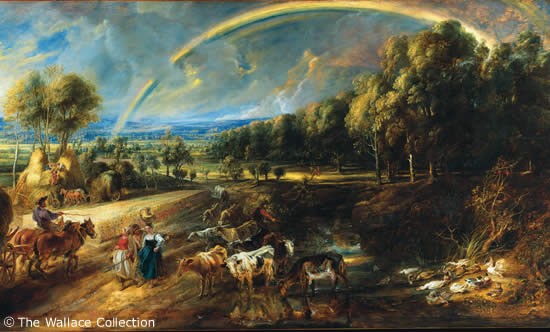 This was one of a pair of paintings which, towards the end of his life, Rubens painted for his own pleasure, both to be hung in his country house home called Het Steen in Belgium. The other painting forming the pair is called An Autumn Landscape with a view of Het Steen (1636), now hanging in the National Gallery, London, could also be said to have qualities which suggest the transcendent but for this reflection I will confine my comments to the picture with the more obvious biblical and typological connections.
To begin by setting the biblical context, there were three covenants which are set out in the book of Genesis, between God and Noah, between God and Abraham and between God and Jacob. I am going to leave the latter two which are not relevant to this painting and follow the theme by considering just the covenant with Noah. After the story of the flood we have God speaking ‘Behold, I establish my covenant with you and your descendants after you, the birds, the cattle and every beast of the earth with you as many as came out of the ark’.[i] Later on referring to the rainbow, we have God speaking again: ‘This is the sign of the covenant which I make between me and you and every living creature that is with you, for all generations: I set my bow in the cloud, and it shall be a sign of the covenant between me and the earth’.[ii]
The interpretation of these passages is that the essence of this covenant is that humankind is required to exhibit a basic reverence towards all life and, in return, God promises never again to flood creation out of existence. There is a typological link here with the New Testament book of Revelation where the writer (possibly John the Apostle) states ‘And he who sat there appeared like jasper and carnelian, and round the throne was a rainbow that looked like an emerald’.[iii]
Returning now to this painting, the Landscape with a Rainbow (1636) was not designed as an altarpiece, but the question nonetheless can be asked – could it be used as an altarpiece? Whilst the link with the New Testament is fairly tenuous, the modern interpretation of the Genesis creation stories together with the Noachide Covenant suggests a concern for stewardship of the world (first creation story) and care for all living creatures (second creation story) which is entirely consistent with the overall message of the New Testament which is that one should worship the one true God and love one’s neighbour. I will therefore argue that this painting is certainly capable of being used as an aid to worship in a church building and could even be used as an altarpiece.
First, the painting is a celebration of rural life and the bounty that is provided by mankind acting as a steward on behalf of God. A storm has just passed emphasising the need for water (rainfall provided by God) to encourage the crops to grow, haymaking, which has halted for the rain is about to re-start, with the workers building ricks in the middle distance. The cows are being moved perhaps towards a milking point in a field as they are accompanied by the milkmaids; this perhaps highlights the need for careful husbandry of the cattle in order to ensure an ample supply of milk.
However, more important than all of this detail there is the significance of the rainbow which was painted to provide a bridge from the dark brooding woods into the much lighter distance – a area of the countryside whose distance is emphasised by the aerial perspective and perhaps represents, or, at least could, represent the heavenly kingdom. It must be remembered that this picture was painted about thirty years before Newton established precisely the scientific basis of the rainbow, and hence the rainbow at that time would have been regarded as a sign from God.
In the particular reproduction that I am examining the colour green is prominent and it is possible that Rubens is alluding to the above mentioned passage in Revelation but whilst some of the colours appropriate to jasper have been reproduced there is no suggestion of the red of carnelian, so one would have to be cautious about reading a reference to Revelation in this painting, particularly as in the other Rubens pictures showing rainbows, the colour scheme is the same with the predominance of yellow and/or green.
I suggest a more plausible typological link with the rainbow is with that of Pentecost. Just as the Passover has always been linked with the Exodus, then the rainbow, the covenantal sign, has been associated with the Feast of Weeks which occurred 50 days after the harvest; hence the name Pentecost when the Paraclete (Comforter or Holy Spirit) which had been promised by Christ just before his ascension, actually arrived. The possibility that this painting has a connection to the promised Holy Spirit cannot be ruled out and gives a further reason for the use of the painting to assist with meditation or devotion. Retired Dean of Christ Church, Oxford, John Drury has a rather different interpretation of the detail of this picture and summarises the painting as follows:
This is a picture which implies God as an appreciative spectator within it of his latest artefact, the rainbow, and of his whole creation. It is also Ruben’s own offering of thanks for his fulfilment as painter and parvenu landowner, in a country restored to economic prosperity under benevolent Christian regents after war and depression. As spectators we stand before it as receivers of blessings. We should hesitate to advance and tangle with the cows. Better to stand still and let all this abundance pour into our laps – or rather eyes.[iv]
I agree with many of Drury’s comments but would disagree with his first sentence. I see God as the Creator and Rubens the spectator bringing God’s creation to the attention of the viewer. The concept of God as spectator almost suggests God as a physical reality somewhere ‘out there’ rather than as a spiritual reality, beyond time and space and greater than anything of which we can conceive. Certainly, as spectators we stand before this painting as receivers of God’s blessing and for this reason, if not for a number of others, I would argue strongly that this picture could easily serve its purpose as an artefact to inspire devotion in the viewer.
As this painting and its companion piece the Autumn Landscape with a view of Het Steen were painted towards the end of his life, one can speculate on whether or not the change of scene signified a change of outlook in Rubens. Many of his earlier works were of traditional altarpieces but maybe by this time in his life he wished to express that which Drury argues was the mind-set of a devout Christian in the mid-seventeenth century when, as he writes:
In the two-world structure of apocalyptic cosmology and in paintings based upon it, heaven was the predominant realm of value and the fulfilment of vision, earth a subordinate place. Rubens could do that too, whether with a moral generosity or a bourgeois biddability to aristocratic commands … But in the freedom of his final years the balance was, without the least trace of apostasy from the Catholic Church, the other way. If cosmologies and systems have their day and cease to be, love, as St. Paul taught, abides. Its descent into mundane existence is the dynamic of Christ’s story, the Christian arch-myth with the world as its destination. Taken on by Christ’s followers, it survives and finds plenty of work to do in our world … In Christian doctrine and devotion, dying (metaphorically including any kind of loss) is a gate to new life when love is its motive. It applies as much to Christianity itself as an historical phenomenon as to the individual Christian such as Rubens.[v]
To examine this quotation in more detail, at the time of Rubens heaven would by most people be seen as a physical place above the sky, (it must be remembered that it was in 1632 that Galileo was imprisoned for supporting the Copernican view of the universe), which explains Drury’s use of the phrase two-world structure of apocalyptic cosmology. This, of course, is consistent with Rubens painting the two worlds (earth represented by the dark woods and the foreground subjects, and the kingdom of heaven towards the distant horizon) joined by the rainbow. The word love needs explanation for it is a translation of the Greek word agape – Christian love, which I always equate with the concept of wanting the best for one’s fellow human being – and it is not to be confused with eros or philios, sexual love and parental love respectively. Drury is extending the use of love (which is sometimes used to define God) into the idea of human destiny being to look after the world to the best of our ability – acting as regent or steward on behalf of God and of being ‘in Christ’ to use St. Paul’s expression.[vi] If we accept this argument, then it follows that Rubens was – by using his God-given talent and experience – ‘infused with the divine’, expressing the ensoulment of creation in his landscape paintings and particularly in Landscape with a Rainbow.[vii]
It is then a very small development of the concept of ensoulment to suggest that the painting has just as much relevance to be used for devotional and meditational purposes as the traditional altarpieces depicting the Madonna or Christ.
Dr David Greenwood d.greenwood@uwtsd.ac.uk August, 2020
[i] Genesis, Chapter 9, verses 9 and 10.
[ii] Genesis, Chapter 9, verses 12 and 13.
[iii] Revelation Chapter 4, verse 3.
[iv] Drury, J. Painting the Word – Christian Pictures and their Meanings New Haven and London Yale University Press 2000 p. 151.
[v] Ibid. p. 153.
[vi] Whole treatises have been written on Christian love, particularly in connection with God loving the world so much that he sent his only son to expatiate for the sins of the inhabitants of the world. See, for example the first letter of John Chapter 4, verses 9 and 10: ‘In this the love of God was disclosed to us, that God sent his only son into the kosmos, that we might live through him. In this is love, not that we loved God but that he loved us and sent his son as a hilasmos for our sins’. Kosmos relates to the whole of the sinful community whilst hilasmos refers to forgiveness, but with also a sense of sacrifice. For a more detailed exposition see, for example, Grayson, K. Dying, We Live – A New Enquiry into the Death of Christ in the New Testament London Darton, Longman and Todd 1990 pp. 276-282.
[vii] Oskar Bätschmann introduces the concept of ensoulment when he refers to Gustav Carus’s description of the ultimate in landscape painting when ‘science and art combine to produce an image that aims at nothing less than the all-embracing ensoulment of nature’. See: Carus,C.G. Nine Letters on Landscape Painting (Introduction by Oskar Bätschmann) Los Angeles, CA The Getty Research Institute 2002 p.7.
 Brislington Community News